
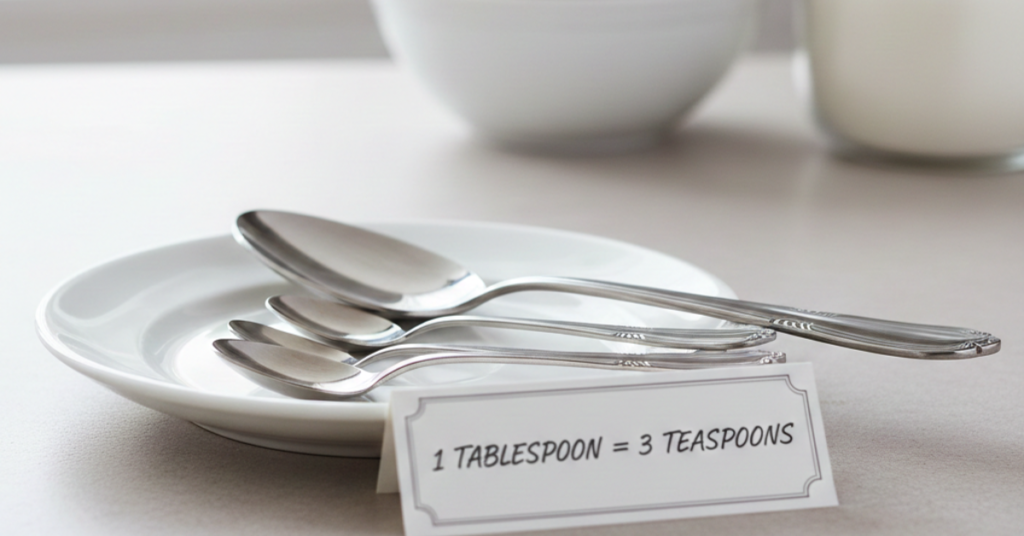

If you’ve ever been halfway through a recipe and realized you’re missing a tablespoon, you’re not alone. Knowing how many teaspoons in a tablespoon can save time, prevent kitchen disasters, and make cooking feel a whole lot easier.
In this guide, we’ll break down the exact conversion, explain US vs UK differences, and show how it applies to common ingredients like sugar, butter, and flour—all in plain, everyday language.
So, How Many Teaspoons in a Tablespoon?
Let’s get straight to the point.
The standard conversion
-
1 tablespoon = 3 teaspoons
This rule applies to US measurements, which are used in most online recipes, cookbooks, and food blogs.
If you’re asking how many teaspoons in a tablespoon?, the answer is almost always three—but there are a few details worth knowing.
How Many Teaspoons in a Tablespoon (US vs UK)
Measurements can change slightly depending on where the recipe comes from.
US tablespoon
-
1 tablespoon = 3 teaspoons
-
1 tablespoon = 15 milliliters
UK tablespoon
-
1 tablespoon = 3 teaspoons
-
1 tablespoon = 15 milliliters (modern standard)
Older UK cookbooks may list a tablespoon as 20 ml, but today, how many teaspoons in a tablespoon UK is still counted as three.
How Many Teaspoons in a Tablespoon of Sugar?
For granulated sugar, the conversion is straightforward.
-
1 tablespoon of sugar = 3 teaspoons of sugar
This applies whether you’re measuring white sugar, brown sugar (loosely packed), or powdered sugar. The volume stays the same, even if the weight changes slightly.
How Many Teaspoons in a Tablespoon of Butter?
Butter measurements can be confusing, especially when switching between sticks and spoons.
-
1 tablespoon of butter = 3 teaspoons
-
3 teaspoons = 1 tablespoon = 14–15 grams of butter
If a recipe asks for teaspoons instead of tablespoons, this conversion keeps things accurate.
How Many Teaspoons in a Tablespoon of Flour?
Flour measurements depend on how it’s scooped, but volume-wise:
-
1 tablespoon of flour = 3 teaspoons of flour
For best results in baking, lightly spoon flour into your measuring spoon rather than packing it down.
Quick Conversion Table (Handy for the Kitchen)
-
1 tablespoon = 3 teaspoons
-
2 tablespoons = 6 teaspoons
-
3 tablespoons = 9 teaspoons
-
4 tablespoons = 12 teaspoons
Saving this chart can make everyday cooking faster and stress-free.
Why This Conversion Matters in Cooking & Baking
Understanding how many teaspoons in a tablespoon US matters more than you might think.
It helps you:
-
Adjust recipes without ruining flavor
-
Measure accurately without extra tools
-
Avoid baking mistakes caused by wrong ratios
In baking especially, small measurement errors can lead to big disappointments.
Common Measuring Mistakes to Avoid
-
Mixing up teaspoons (tsp) and tablespoons (tbsp)
-
Using regular cutlery instead of measuring spoons
-
Packing ingredients when the recipe says “level”
Accurate measurements = better results every time.
FAQs About How Many Teaspoons in a Tablespoon
How many teaspoons in a tablespoon exactly?
Exactly 3 teaspoons make 1 tablespoon in standard cooking measurements.
Is the conversion the same in the US and UK?
Yes. Modern US and UK cooking both use 3 teaspoons per tablespoon.
How many teaspoons in a tablespoon of flour or sugar?
Both flour and sugar follow the same rule: 3 teaspoons = 1 tablespoon.
Why do some sources show different numbers ?
Older measurement systems or confusion between weight and volume can cause differences, but modern recipes use the standard conversion.
Can I use teaspoons if I don’t have a tablespoon ?
Absolutely. Just use three level teaspoons for every tablespoon needed.
Conclusion: Remember This One Simple Rule
When it comes down to it, remembering how many teaspoons in a tablespoon is easy: three teaspoons equal one tablespoon. This simple conversion works for US and UK recipes and applies to ingredients like sugar, butter, and flour.